Adhesive conductive tapes are among the most practical and beginner-friendly materials for SPOKE builds. Press them onto paper, card, wood, or fabric to create instant circuit traces - no soldering required to get started.
Copper tape is a thin, flexible adhesive tape with a copper foil surface. It's the go-to material for paper circuits, greeting cards, and wearable paper projects - and it can be soldered directly.
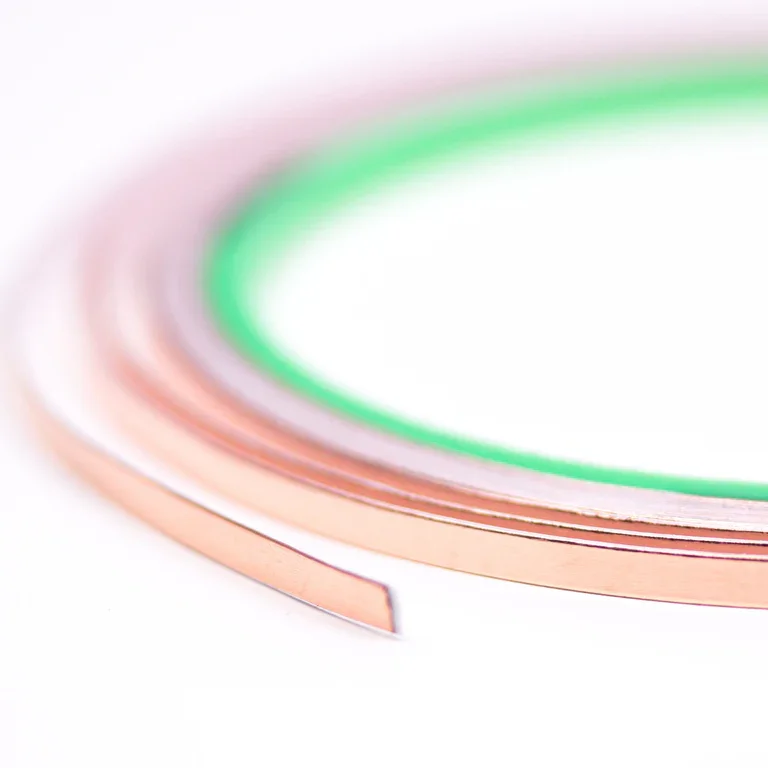
- Use conductive adhesive tape where possible - this ensures joins and corners stay electrically connected.
- Fold tape at corners rather than cutting - this maintains a continuous conductor around bends.
- Pinch overlapping joins firmly with your fingernail to reduce resistance at contact points.
- Solder can be applied directly to copper tape for more robust, permanent connections.
- Available in widths from 3mm to 50mm+ - wider tape has lower resistance over distance.
Project: Light-up greeting card ↗
This is the thick, silver, self-adhesive foil tape used to seal ducting and insulation in construction. It's substantially sturdier than copper tape - the foil is thicker, the adhesive is aggressive, and it stands up well to repeated handling. An excellent alternative to copper tape when durability matters more than aesthetics.
- Available cheaply from any hardware or DIY shop - look in the plumbing or HVAC aisle.
- The foil is thicker than copper tape and resists tearing - good for projects that will be handled a lot.
- The adhesive is very strong - plan your layout before sticking, as repositioning is difficult.
- Folds and corners cleanly like copper tape - fold rather than cut for continuous traces.
- Not solderable, but accepts crocodile clips and conductive paint bridges well.
- The shiny silver finish can look intentional and attractive in the right project aesthetic.
Metallic foils offer beautiful aesthetic possibilities for SPOKE projects - from humble kitchen aluminium to decorative gold and copper leaf. Conductivity varies by material and thickness, so always test with your board before committing to a design.
Standard kitchen aluminium foil is surprisingly effective as a conductor. It's cheap, universally available, and easy to cut into any shape.
- Cut into strips or shapes and secure with tape - foil doesn't hold adhesive well on its own.
- Works brilliantly as a touch pad or pressure sensor against another foil surface.
- Scrunching increases resistance - keep traces flat and smooth for best results.
- Avoid aluminium oxide build-up on older foil - wipe with a dry cloth before use.
Imitation gold leaf (brass-based) is conductive and creates a stunning aesthetic for artistic SPOKE projects. Real gold leaf is also conductive but rarely needed - imitation leaf performs very well and costs a fraction of the price.
- Apply over size (gilding glue) - press the leaf gently and brush away excess once dry.
- Overlapping sheets maintain conductivity across joins.
- Works best on smooth, non-porous surfaces like card and wood.
- Seal carefully - most varnishes will insulate the surface.
- Combine with SPOKE's capacitive sensing for interactive art pieces.
Copper leaf offers excellent conductivity in a delicate, decorative form. It oxidises over time which can increase resistance - seal or use promptly for best electrical performance.
- Apply using the same gilding size method as gold leaf.
- Apply a clear lacquer quickly - copper oxidises faster than gold.
- Beautiful in combination with copper tape traces for a unified aesthetic.
- Avoid touching with bare hands during application - oils cause patchy adhesion.
Many organic materials conduct electricity thanks to their water and mineral content. This makes them perfect for playful, surprising, and educational SPOKE workshops - nothing beats the delight of a potato playing a drum beat.
Potatoes are one of the best organic conductors for public-facing events and installations. Their starch and mineral content makes them reliably conductive, and unlike soft fruits they hold their shape for days without deteriorating - no mush, no mess, no need to replace mid-event.
- Raw potato works best - cooking breaks down the ionic structure that makes it conductive.
- Push a drawing pin, screw, or small bolt into the potato to create a firm, reliable connection point.
- The cut face of a sliced potato has a larger contact area - useful if you want to embed copper tape traces directly onto the surface.
- A grid of potatoes makes a surprisingly robust drum pad or keyboard for a workshop table.
- Larger potatoes (baking size) sit more stably and are easier for participants to touch.
A crowd-pleasing classic for short workshops and demonstrations. Bananas are consistently conductive and universally recognised - perfect for showing beginners of all ages that everyday objects can trigger sounds and interactions. Best for single-session use rather than extended public displays.
- Connect via crocodile clip - pierce the skin slightly for a reliable connection.
- Riper bananas tend to be more conductive due to higher sugar and moisture content.
- A bunch makes a playable piano keyboard - each banana on a separate SPOKE input.
- Great for live demos where the reaction is immediate and the wow factor is high.
Fresh mushrooms - particularly the gills and cap - can conduct electricity. Their high moisture content makes them responsive to touch, opening up possibilities for nature-inspired interactive sculpture.
- Use fresh, not dried - moisture is the key conductor here.
- Insert a small screw or pin into the stem for a secure clip point.
- The gills are particularly responsive - try connecting across both sides of the cap.
- Works well in foraged-aesthetic or bio-art projects.
The world of organic conductors is wide. Experiment with anything high in water or ionic content - you may be surprised what talks to your SPOKE board.
- Citrus fruits - lemons, oranges, limes all work well. Squeeze a little juice onto the contact point to improve connection.
- Aloe vera gel - thick and conductive, can be applied with a paintbrush as a trace.
- Saltwater-soaked felt or sponge - a classic pressure-pad material.
- Damp soil - great for plant-interaction projects where roots become the sensor.
- Human skin - your body is a conductor; SPOKE's capacitive inputs exploit this directly.
Solid metals offer the most reliable and durable conductive connections for SPOKE projects. They're ideal where longevity and structural integrity matter - sculptural works, installations, and semi-permanent builds.
Pewter is a low-melting-point alloy that can be cast and shaped at home with simple tools. Its dull, antiqued appearance makes it well-suited to craft and object-making contexts alongside SPOKE electronics.
- Melt in a small ladle on a gas hob - melts around 170-230°C depending on alloy.
- Pour into silicone moulds to create custom button shapes, toggles, or contact pads.
- Sand cast in a tray of damp sand for organic, rough-textured forms.
- Avoid alloys containing lead - look for lead-free casting pewter.
- File or sand contact surfaces to remove any oxide layer before connecting to SPOKE.
Standard plumbing copper pipe is an excellent structural conductor. It can be cut, bent, and joined into sculptural frames or touch-points, and connects easily to SPOKE via crocodile clips or soldered wires.
- A pipe cutter gives clean, burr-free edges - avoid hacksaws where possible.
- Pipe can be bent cold with a spring bender for gentle curves.
- Solder wire connections directly to pipe using standard flux and solder.
- Use compression fittings to join sections without heat - great for classroom settings.
- Wipe with wire wool or fine sandpaper before connecting - copper oxidises and the oxide layer increases resistance.
Off-the-shelf hardware from a builder's merchant or DIY shop can make excellent conductive interfaces. These materials are durable, inexpensive, and bring a satisfying industrial or craft character to SPOKE builds.
Brass and steel upholstery nails can be hammered into wood, leather, or cork to create beautiful tactile touch pads. Their broad domed heads make excellent finger contacts.
- Hammer into a backing board and connect wire to the shaft from underneath.
- Space nails to create a playable grid or keyboard layout.
- Brass nails are more reliably conductive than steel - check before buying.
- Combine with leather or cork backings for an attractive handmade feel.
Nuts and bolts make sturdy, reliable connection points for SPOKE. The threaded shaft gives you a mechanical fixing and an electrical conductor in one, and they can be reconfigured by hand without tools.
- M3 or M4 bolts work well - standard sizes fit most craft and project boards.
- Wrap a wire under a washer before tightening the nut for a clean, removable connection.
- Prefer brass or zinc-plated steel bolts over stainless - stainless is less conductive.
- Create removable patch panels: a grid of bolts where croc-clip wires can be plugged in to change the circuit.
Bare copper wire is one of the most flexible conductive materials available. It can be woven, coiled, twisted into forms, or used as exposed structural traces in sculptural SPOKE builds.
- Copper wire (uncoated) from a reel is cheap and easy to shape by hand.
- Coil wire into springs to make pressure-sensitive contacts - press down to connect two surfaces.
- Weave wire through fabric or card to embed conductive paths invisibly.
- Use thicker wire (0.8mm+) for structural elements, fine wire (0.2mm) for detail work.
- Annealed (softened) wire is easier to shape - pass through a flame briefly if it's too springy.
Conductive paints and inks let you draw or paint circuit traces onto almost any surface. They bridge electronics and art in an expressive way - perfect for SPOKE builds that start as illustrations.
Silver or carbon-based conductive paints (such as Bare Conductive Electric Paint) can be brushed, stamped, or screen-printed onto paper, card, wood, ceramics, and more.
- Apply in multiple thin layers - let each dry fully before the next for lower resistance.
- Wider traces have lower resistance; narrow ones may struggle over longer distances.
- Use a ruling pen or masking tape stencil for clean, straight lines.
- Can be used as a paint-on solder replacement for attaching small components.
- Test continuity with a multimeter before connecting your SPOKE board.
Bare Conductive ↗
Traditional India ink contains carbon black, giving it a small but measurable conductivity. While not as conductive as dedicated paints, it's sufficient for short traces and capacitive touch sensing with SPOKE's sensitive inputs.
- Works best for capacitive sensing (touch detection) rather than power circuits.
- Apply thickly and in multiple layers - thin washes have very high resistance.
- Ruling pen application gives clean, consistent traces.
- Use on printmaking or watercolour paper which holds ink without spreading.
- Beautiful with pen-and-ink illustration styles - the technology disappears into the artwork.
Conductive textiles open up soft, wearable, and tactile applications for SPOKE. Fabric-based interactions have a warmth and intimacy that hard electronics rarely achieve.
Stainless steel or silver-coated thread can be sewn through fabric to create soft, flexible circuit traces by hand or sewing machine.
- Use a simple running stitch for straight traces - backstitch for lower resistance.
- Keep thread paths short; resistance increases with length.
- Avoid crossing conductive traces without insulation - a small fabric patch works as an insulator.
- Knot ends securely and apply a small dab of clear nail varnish to prevent fraying.
How To Get What You Want (e-textiles) ↗
Woven or non-woven conductive fabrics can be cut, glued, or sewn into shape. They make excellent large-area touch pads, pressure sensors, and shielding materials.
- Cut with sharp fabric scissors - fraying edges can cause shorts if not hemmed or sealed.
- Two layers separated by a foam spacer make a simple pressure sensor.
- Velostat (pressure-sensitive conductive plastic) pairs well for variable-resistance inputs.
- Test with a multimeter across the fabric surface before sewing into a project.
3D printing opens up possibilities for custom-shaped conductive parts that would be impossible to fabricate by hand. Combined with SPOKE, you can design and produce fully bespoke interface objects and enclosures.
Carbon-loaded PLA and other conductive filaments allow you to print objects that conduct electricity. Resistance is much higher than metal, but sufficient for touch sensing and short low-current traces with SPOKE.
- Print traces vertically (Z-axis) - layer adhesion gives lower resistance than horizontal spans.
- Use dual-extrusion to print conductive paths embedded inside non-conductive shells.
- Lower layer height (0.1mm) improves inter-layer conductivity.
- Proto-pasta and Recreus FilaFlex conductive are popular brands worth trying.
Electroplating deposits a thin metal layer onto a 3D printed object, giving it the conductivity of metal with the form freedom of printing. More achievable at home than many people expect, and produces stunning results for sculptural SPOKE interfaces.
- Prime the print with conductive paint or graphite spray before plating to ensure an even base layer.
- Copper plating is the most accessible starting point - copper sulphate solution and a basic power supply are all you need.
- Follow with nickel or chrome for decorative finishes over the copper base.
- Watch Hen3drik's channel for exceptional tutorials on this exact process.
Hen3drik on YouTube ↗
Some of the most interesting SPOKE builds come from unexpected material experiments. These don't fit neatly into categories but are well worth exploring.
Pure graphite - found in pencil cores, graphite powder, and graphite spray - is a good conductor for a non-metal. One of the most accessible experimental conductors you can use with SPOKE.
- A soft pencil (6B or 8B) leaves a thick, conductive layer - draw multiple overlapping passes.
- Graphite spray paint covers large areas quickly and bonds well to most surfaces.
- Graphite powder mixed with PVA glue makes a brushable conductive paste.
- Best suited for capacitive touch sensing rather than power circuits.
- Keep your work area clean - graphite dust conducts and can cause unintended shorts.
You can make your own pressure-sensitive conductive material by blending carbon black or graphite powder into silicone rubber. The result changes resistance under compression - perfect for making custom pressure sensors for SPOKE.
- Mix graphite powder or carbon black into two-part silicone at around 20-30% by weight.
- Pour into moulds for custom-shaped sensor pads or buttons.
- Resistance decreases when compressed - SPOKE can read this as a variable input.
- Velostat is a ready-made commercial alternative if you don't want to mix your own.
- Experiment with different carbon ratios - more carbon = lower base resistance.